
Quotation


Performance
AI-Based Criminal Justice and Legal Innovation Conference Simultaneous Interpretation | Artificial Intelligence Law · Criminal Justice Reform · Legal Technology Forum – UNIVERSE RB
- 2025.08.20
Public Policy & Global Governance
Category
Description
This category covers interpretation cases related to international policy
forums, public cooperation initiatives, ODA programs, and global governance
topics including environmental and climate policy.
UNIVERSE RB provides integrated services including:
Simultaneous interpretation Consecutive interpretation International conference interpretation Policy document translation QMS-based quality management operations
We support international policy forums, government cooperation meetings, and global governance conferences with stable interpretation environments.
Executive Summary
The AI-Based Criminal Justice & Legal Innovation Conference examined the transformation of investigative procedures, prosecution systems, court decision-making, and correctional frameworks through artificial intelligence—while addressing legal, ethical, and human-rights implications.
-
Total Participants: 180+ judges, prosecutors, policymakers, AI researchers
-
Specialized Terminology: 900+ legal, regulatory, and AI-technical terms
-
AI Structural Support: 56% (terminology clustering, statute alignment, acronym consistency)
-
Human Legal Interpretation: 100% (due-process nuance, ethical sensitivity, regulatory precision)
-
Legal / Conceptual Error: 0 cases
-
QMS 9-Step Applied
AI-justice conferences require simultaneous mastery of legal doctrine, algorithmic systems, and human-rights discourse to ensure credibility and institutional trust.
Event Overview
The conference focused on:
-
Predictive policing and AI-driven investigations
-
Digital forensics and biometric analytics
-
Sentencing support algorithms and automated legal research
-
Recidivism risk modeling and correctional AI tools
-
Algorithmic bias, accountability, and due process
-
EU AI Act and global regulatory frameworks
Participants included:
-
Judges and prosecutors
-
National police officials
-
AI researchers and data scientists
-
Legal scholars
-
Human-rights experts
-
Policy regulators
This communication environment integrates criminal law, constitutional principles, machine-learning systems, and regulatory governance simultaneously.
Why This Interpretation Was Complex
1) Legal Precision Requirements
Due process, judicial authority, liability frameworks, statutory interpretation.
2) Algorithmic & Technical Concepts
Risk assessment models, training datasets, predictive analytics, bias mitigation mechanisms.
3) Ethical & Human-Rights Sensitivity
Fairness, discrimination concerns, proportionality, privacy rights.
4) Regulatory Complexity
EU AI Act (high-risk AI classification), national legal codes, data-protection laws.
5) Institutional Credibility Risk
Misinterpretation may undermine public trust in judicial systems.
Legal-technology forums demand absolute precision and neutrality.

AI + Human Interpretation Architecture
| Segment | AI Role | Human Expert Role | Ratio |
|---|---|---|---|
| Technical AI presentations | Terminology alignment, acronym mapping | Conceptual clarification | 60% AI |
| Legal doctrine sessions | Statute structuring | Judicial nuance & formal tone | 100% Human |
| Ethics & rights discussion | Terminology support | Neutral, balanced framing | 100% Human |
| Policy panel & Q&A | Context tracking | Regulatory sensitivity control | 100% Human |
AI stabilizes structure.
Human experts manage legal nuance, ethical balance, and institutional authority.
QMS 9-Step Application
-
Pre-event statute and regulatory review
-
AI-justice glossary construction (900+ terms)
-
Legal-risk exposure mapping
-
Interpretation architecture design
-
Confidentiality and compliance check
-
Real-time terminology validation
-
Legal-precision monitoring
-
Post-session doctrinal review
-
Continuous improvement archive
AI-criminal-justice forums require integration of constitutional principles and algorithmic terminology before execution.
Case Application
■ Industry Context
Governments worldwide are integrating AI into policing and judicial systems while facing increasing scrutiny regarding fairness and accountability.
■ Communication Risk
Misinterpretation of bias findings, legal authority, or regulatory classification may distort public policy understanding.
■ Interpretation Strategy
-
Strict statute-preserving translation
-
Clear differentiation between algorithmic model vs. judicial decision
-
Balanced delivery of ethical concerns
-
Maintenance of institutional neutrality
■ Result Metrics
-
0 statutory misstatement
-
0 regulatory distortion
-
100% clarity in bias and accountability discussions

Representative Case Highlights
Case 1 – COMPAS Algorithm (United States)
Recidivism risk prediction tool used in sentencing support.
Interpretation emphasis: “Algorithmic Bias” (알고리즘 공정성 문제) and fairness implications.
Case 2 – Estonia’s e-Justice Pilot
AI-assisted judge for civil claims under €7,000.
Interpretation emphasis: Clarify supervisory role of human judges and limited jurisdiction.
Case 3 – Smart Policing in Korea
AI-based CCTV and big-data crime-zone analysis.
Interpretation emphasis: Natural rendering of “Smart Policing” as “스마트 치안 시스템” with contextual explanation.
Case 4 – EU AI Act (2024)
Classification of predictive policing and biometric surveillance as high-risk AI.
Interpretation emphasis: Formal legal register and precise regulatory language.
Global Visibility Statement
UNIVERSE RB does not provide language services based solely on interpreter availability.
We design communication architecture based on constitutional sensitivity, algorithmic complexity, regulatory exposure, and institutional credibility.
AI supports structural consistency.
Human experts manage legal authority, ethical nuance, and public-trust implications.
Quality is engineered.
FAQ
Why is AI-criminal-justice interpretation high-risk?
Because legal terminology, algorithmic bias findings, and regulatory frameworks directly affect judicial legitimacy and public trust.
Can AI-only interpretation manage legal-technology forums?
AI can align terminology but cannot independently manage constitutional nuance or ethical balance.
How do you prepare for statute-heavy sessions?
We review legal codes, regulatory documents, and AI technical materials in advance.
Is simultaneous interpretation recommended?
Yes, especially for keynote and policy discussions.
Do you support legal document translation?
Yes, including regulatory summaries, compliance guidelines, and judicial research papers.
Pricing Determination Conditions
Pricing is determined by:
-
Language pair complexity
-
Legal specialization depth (criminal law, constitutional law, regulatory law)
-
AI-technical complexity level
-
Human-rights and ethical exposure
-
Event duration
-
Onsite vs Remote format
-
Equipment tier
-
AI utilization ratio
-
Pre-analysis hours required (statute + technical review)
-
Institutional and public-visibility sensitivity
AI-justice conference interpretation reflects legal and constitutional risk exposure—not duration alone.
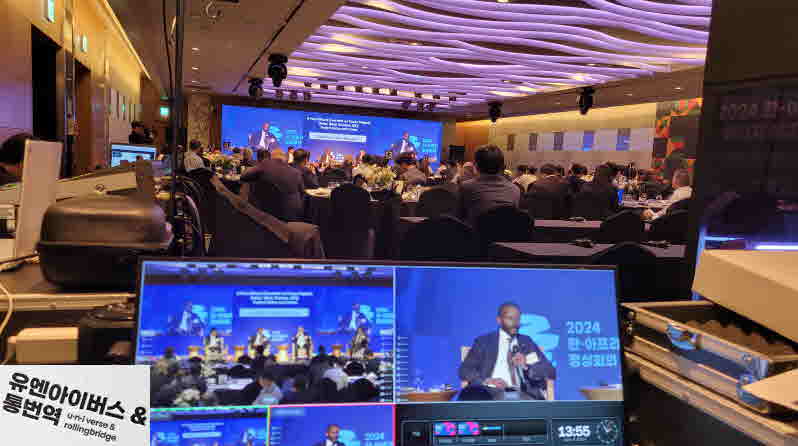
In large-scale international seminars, stable multilingual communication is achieved when interpretation systems, technical equipment, and interpreter operations are designed as an integrated architecture.
Closing Statement
In AI-driven criminal justice environments, interpretation is not linguistic mediation.
It is constitutional-risk–sensitive, regulation-aware communication architecture.
This
case represents one of the sessions conducted as part of international policy
cooperation and global governance discussions.
Policy environments and international cooperation frameworks continue to evolve
in response to economic, environmental, and development policy changes.
→ View Public Policy & Global Governance Cases
https://universerb.com/en/11_en/152?page=39
https://universerb.com/en/11_en/191?page=39
The case archive on this
website is based on interpretation and global communication experiences
conducted in international seminars, policy forums, corporate presentations,
and industry conferences.
To comply with client confidentiality and the Code of Professional Conduct,
some event details are described in a generalized manner.