
Quotation


Performance
Korea–U.S. Regional Security Environment Outlook Seminar Simultaneous Interpretation | Defense Strategy · Indo-Pacific Security · Strategic Policy Forum – UNIVERSE RB
- 2025.12.16
This international security forum explores the evolving security environment on the Korean Peninsula, Indo-Pacific strategy, alliance cooperation, and emerging global security challenges.
Key interpretation topics include North Korea's nuclear and missile threats, crisis management mechanisms, deterrence and extended deterrence strategies, the Korea–U.S. alliance and combined defense, strategic asset deployment, trilateral security cooperation, U.S.–China strategic competition, the Taiwan Strait and South China Sea, QUAD and AUKUS, cyber and space security, AI-enabled defense systems, supply chain and energy security, the rules-based international order, and future security scenarios.
Because modern security policy integrates military strategy, diplomacy, advanced technologies, economic security, and international governance, professional interpretation is essential to accurately communicate strategic concepts, policy objectives, diplomatic messaging, and multinational security cooperation.
Public Policy & Global Governance
Category
Description
This category covers interpretation cases related to international policy
forums, public cooperation initiatives, ODA programs, and global governance
topics including environmental and climate policy.
UNIVERSE RB provides integrated services including:
Simultaneous interpretation Consecutive interpretation International conference interpretation Policy document translation QMS-based quality management operations
We support international policy forums, government cooperation meetings, and global governance conferences with stable interpretation environments.
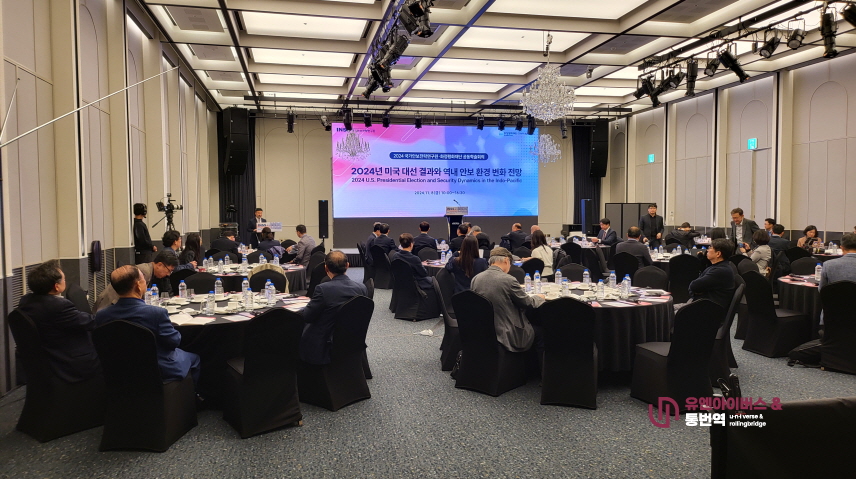
Executive Summary
The Korea–U.S. Regional Security Environment Outlook Seminar is a high-level strategic forum addressing alliance policy, Indo-Pacific security architecture, and emerging military threats.
The event integrates diplomatic discourse, military analysis, geopolitical forecasting, and multilateral security cooperation.
Simultaneous interpretation requires precise security terminology, calibrated tone control, and disciplined neutrality under UNIVERSE RB’s QMS-based strategic defense communication architecture.
1. Overview
The Korea–U.S. Regional Security Environment Outlook Seminar is a high-level security forum where policymakers, military officials, scholars, and international think tanks analyze shifts in the regional security order on the Korean Peninsula and across the Indo-Pacific.
Discussions typically involve officials from the Ministries of National Defense, Foreign Affairs, and Unification; Korean and U.S. military authorities; research institutes; diplomatic representatives; and security experts.
Interpreters must accurately convey diplomatic, military, and strategic terminology while maintaining strict neutrality and a restrained tone, particularly when handling politically or militarily sensitive content.
2. Key Topics
Security Environment on the Korean Peninsula
-
North Korea’s nuclear and missile capability developments
-
Crisis management and escalation control mechanisms
-
Deterrence and extended deterrence strategies
Korea–U.S. Alliance and Combined Defense
-
Evolution of combined defense posture
-
Deployment of strategic assets
-
Trilateral cooperation among Korea, the United States, and Japan
Indo-Pacific Regional Security
-
U.S.–China strategic competition
-
Taiwan Strait and South China Sea dynamics
-
Multilateral security groupings (QUAD, AUKUS)
Emerging Security Threats
-
Cybersecurity and space domain security
-
AI-enabled warfare and unmanned systems
-
Supply chain and energy security
Policy, Diplomacy, and Strategic Outlook
-
Redefining alliance roles
-
Multilateralism and the rules-based international order
-
Scenario-based regional security projections
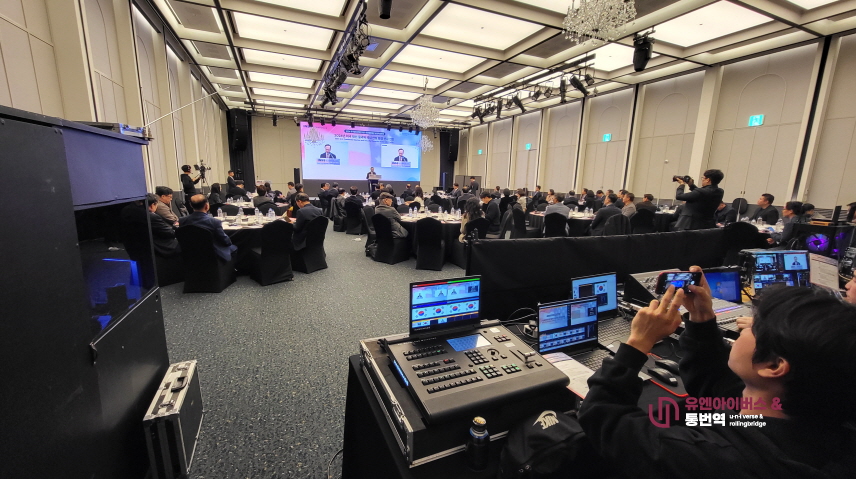
3. Interpretation Format
| Session Type | Content | Interpretation Mode |
|---|---|---|
| Keynote Address | Regional security outlook | Simultaneous |
| Policy Sessions | Alliance and diplomatic strategy | Simultaneous |
| Military Sessions | Force posture & crisis response | Simultaneous |
| Expert Presentations | Strategic analysis & projections | Simultaneous |
| Panel Discussions | Government–military–academia dialogue | Simultaneous |
| Q&A Sessions | Participant interaction | Simultaneous / Consecutive |
4. Required Competencies
-
Advanced understanding of diplomatic and military terminology (deterrence, escalation, force posture, extended deterrence)
-
Foundational knowledge of the Korea–U.S. alliance framework and Indo-Pacific strategy
-
Ability to shift between policy-level statements and operational military analysis
-
Rapid processing of map-based and scenario-driven briefings
-
Strict neutrality in politically sensitive contexts
-
Formal, disciplined language suitable for high-level security forums
5. Practical Interpretation Case Scenarios
Case 1 – Extended Deterrence Briefing
Precise interpretation of layered deterrence concepts involving conventional, nuclear, and missile defense components.
Case 2 – Indo-Pacific Strategic Competition Session
Balanced delivery of geopolitical assessments without amplifying evaluative language.
Case 3 – Crisis Escalation Scenario Analysis
Accurate interpretation of time-sensitive military sequencing and escalation thresholds.
6. Interpretation Notes
Accuracy in Security Terminology
Key terms must be rendered precisely and consistently:
-
Deterrence
-
Extended deterrence
-
Rules-based international order
-
Strategic assets
-
Force posture
-
Escalation control
Maintaining Political Neutrality
Statements regarding threat perception, alliance burden-sharing, or geopolitical rivalry must be interpreted exactly as delivered, without emphasis or mitigation.
Calibrating Diplomatic Intensity
Terms such as “threat,” “risk,” “challenge,” and “pressure” carry different diplomatic weight; the interpreter must mirror the speaker’s original level of intensity.
Managing Dense Security Briefings
Strategic presentations are often fast-paced and layered; interpreters must quickly identify structure—context, current capability, strategic implication, and outlook.
7. Pricing Determination Conditions
Interpretation fees for a Korea–U.S. Regional Security Seminar are determined by:
-
Language combination and security clearance requirements
-
Level of military and strategic complexity
-
Duration and number of simultaneous sessions
-
Presence of high-ranking government or military officials
-
Sensitivity of classified or restricted materials
-
On-site vs. secure hybrid configuration
-
Requirement for ISO-standard interpretation booths and encrypted audio systems
Security and defense forums are categorized as top-tier complexity due to geopolitical sensitivity and strategic depth.

8.FAQ – Korea–U.S. Regional Security Forum Interpretation
1) What type of interpretation is typically used in international security and policy forums?
High-level security forums generally use simultaneous interpretation to ensure real-time multilingual communication during policy briefings, military analysis sessions, and diplomatic discussions.
Simultaneous interpretation allows participants from different countries to follow strategic discussions without interrupting the flow of presentations and debates.
2) Why do defense and security forums require specialized interpreters?
Security forums involve complex terminology related to military strategy, diplomacy, and international relations, such as deterrence, force posture, alliance coordination, and escalation management.
Interpreters must understand both security policy language and military operational concepts to accurately convey the meaning of high-level strategic discussions.
3) How do interpreters maintain neutrality in politically sensitive discussions?
In international security environments, interpreters must follow strict professional standards that emphasize accuracy, neutrality, and disciplined tone control.
Statements regarding geopolitical tensions, alliance strategy, or national security assessments must be delivered exactly as spoken, without emphasis, interpretation, or alteration of intent.

4) What challenges arise when interpreting military and geopolitical briefings?
Strategic security presentations often include maps, operational scenarios, and layered policy analysis delivered at a rapid pace.
Interpreters must quickly identify the structure of the briefing—context, capability assessment, strategic implication, and policy outlook—to ensure accurate interpretation of complex information.
5) What factors influence interpretation planning for high-level security conferences?
Interpretation planning for security forums typically considers several factors:
-
Level of diplomatic and military complexity involved in the discussions
-
Participation of senior government or defense officials
-
Security sensitivity of materials and briefings
-
Interpretation infrastructure requirements, such as secure audio systems and ISO-standard booths
-
Event format, including on-site, hybrid, or restricted-access sessions
Because of geopolitical sensitivity and technical terminology, defense and security forums are generally categorized as high-complexity interpretation environments.
9. Summary
Simultaneous interpretation for the Korea–U.S. Regional Security Environment Outlook Seminar represents one of the most demanding domains in conference interpreting, integrating diplomacy, military affairs, strategic analysis, and geopolitical forecasting.
Core requirements include:
-
Precise security terminology
-
Strict neutrality and disciplined tone
-
Rapid analytical comprehension
-
Structured, high-level delivery
Interpreters function as strategic communication architects, ensuring that alliance discussions and regional security dialogues are conveyed with professionalism, accuracy, and international credibility under the UNIVERSE RB QMS framework.
This
case represents one of the sessions conducted as part of international policy
cooperation and global governance discussions.
Policy environments and international cooperation frameworks continue to evolve
in response to economic, environmental, and development policy changes.
→ View Public Policy & Global Governance Cases
https://universerb.com/en/11_en/102?page=39

About Our Case Archive
The case studies and project insights presented on this website are based on experience supporting international conferences, investor presentations, government forums, executive meetings, technical seminars, and multilingual corporate events.
To protect client confidentiality and comply with the Code of Professional Conduct followed by professional interpreters worldwide, certain project details have been generalized, anonymized, or adapted for educational purposes.
The purpose of these materials is to share practical insights into multilingual communication planning while respecting the confidentiality of every client and every project.
UNIVERSE RB
Designing Communication. Managing Risk. Delivering Understanding.