
Quotation


Performance
[FAQ] What Determines Interpretation Quality?
- 2026.02.21
Professional interpretation and translation quality is not completed by individual skill alone.
Only when there are:
Clear standards
Structured systems
Defined accountability frameworks
can consistently high-quality services be achieved.
UNIBERSE & Rolling Bridge deliver stable and reliable interpretation and translation services based on internationally aligned Quality Management Systems (QMS), ensuring that client expectations and requirements are consistently met.
■ Interpretation Quality Is Completed by a System, Not Just a Person
Interpretation quality is not determined solely by interpreter expertise.
It is the result of a comprehensive system design that includes:
✔ Acoustic environment
✔ Equipment performance
✔ Pre-event glossary preparation
✔ Understanding of event structure
✔ Operational management framework
All of these components combine to determine final service quality.
■ The Greatest Risk in Language Services: Quality Variability
Interpretation and translation are human-performed professional services.
Even highly skilled experts cannot maintain consistent quality without structured management systems.
UNIBERSE & Rolling Bridge systematically manage every factor affecting quality, minimizing service variability.
The core of this approach is our Quality Management System (QMS).
■ Quality Management Recognized in the Asian Market
UNIBERSE has earned recognition from global companies operating across Asia for its quality management capabilities.
First Korean company approved as a full member of the Association of Translation Companies (ATC)
Approved in the Korean language service sector by the American Translators Association (ATA)
These recognitions signify not merely membership, but the practical implementation of international standards in quality, ethics, and operational governance.
■ QMS Operational Structure
UNIBERSE’s QMS operates through the following framework:
1. KPI (Key Performance Indicator) Establishment
Quantitative quality targets
Monitoring of client satisfaction, retention rates, and error ratios
2. Quality Monitoring Process
Pre-event briefings and glossary management
On-site operational checklists
Post-event evaluation and feedback integration
3. Professional Personnel Management & Motivation
Performance recognition systems
Continuous education and training programs
Quality is managed not by intuition, but by metrics and systems.
■ The Meaning of ATA Standards
The American Translators Association (ATA), founded in 1959, is the world’s largest professional association for translators and interpreters, with members in over 80 countries.
ATA standards require:
Professional credential verification
Compliance with the Code of Professional Conduct and Business Practices (CPCBP)
Demonstrated service quality and management transparency
Adherence to fair competition principles
ATA recognizes interpretation and translation as a profession, not merely a service.
■ The Meaning of ATC Standards
The Association of Translation Companies (ATC), established in 1976, is one of the world’s oldest associations for language service companies.
Full membership requires:
Professional indemnity insurance
Compliance with a Code of Professional Conduct
Accuracy verification systems
Demonstrated operational track record
Qualified personnel capacity
Confidentiality and commercial ethics compliance
ATC is a founding member of the EU language industry federation and plays a role in customer rights protection and dispute mediation.
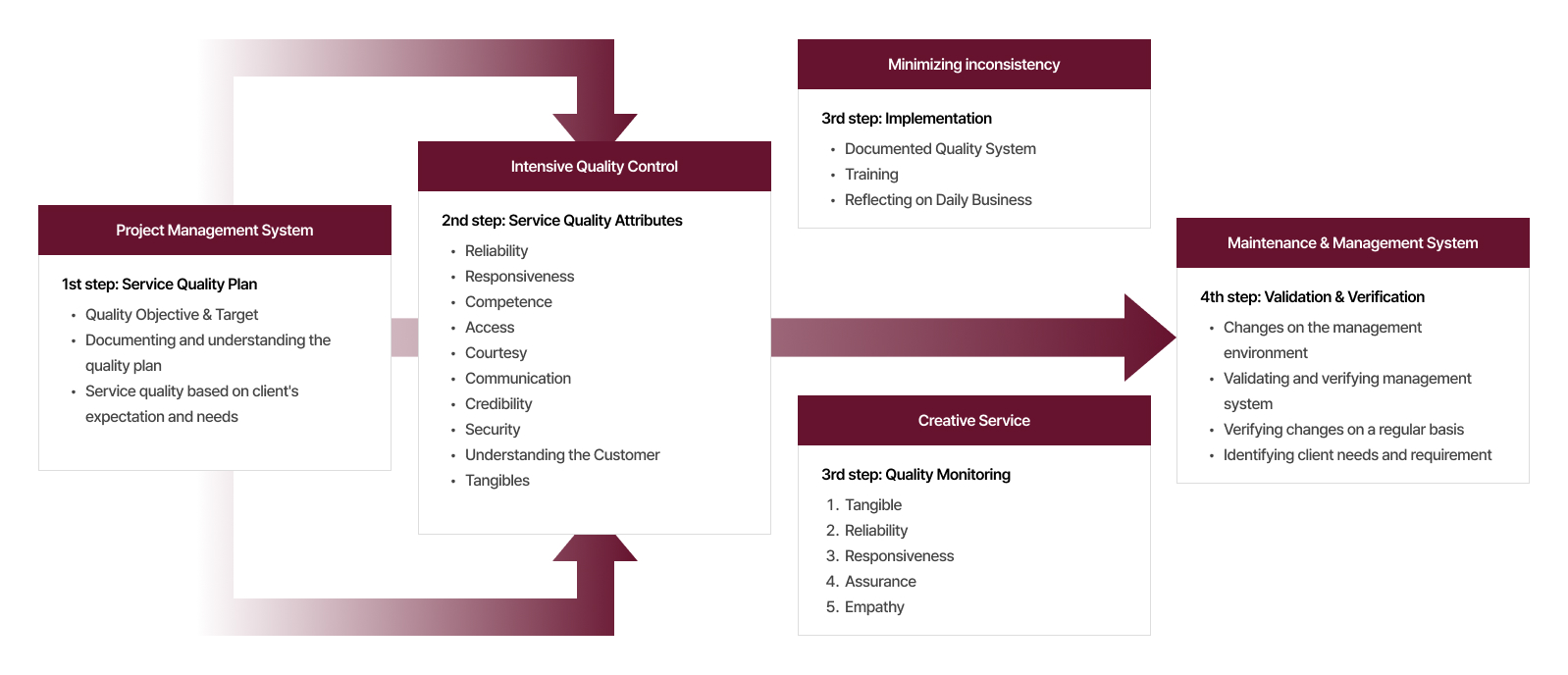
■ UNIBERSE 4-Stage Quality Management Cycle
① Quality Policy Definition
Establishing quality strategy based on client expectations and needs
② Quality Objective Setting
Quantitative target setting and training standards
③ Implementation & Monitoring
Continuous quality checks, documentation, and performance analysis
④ Periodic Review & Improvement
Reflecting changes in management environments and evolving client requirements
Through this cyclical structure, quality is not only maintained—but continuously improved.
FAQ | Translation & Interpretation Quality Management (QMS) and International Standards
Q1. What determines the quality of interpretation?
Interpretation quality is not determined solely by the interpreter’s individual skills.
Stable, high-quality interpretation requires the integration of several elements, including:
Audio environment
Interpretation equipment performance
Terminology preparation
Understanding of event structure
Operational management systems
In practice, high-quality interpretation is achieved when professional expertise and well-designed systems work together.
Q2. What is the biggest risk in interpretation and translation services?
The most significant risk in interpretation services is quality variation.
Because interpretation is performed by human professionals, inconsistent management can lead to issues such as:
Differences in interpretation quality
Incorrect terminology delivery
Misinterpretation of key messages
For this reason, a structured quality management system is essential.
Q3. What is a Quality Management System (QMS)?
QMS stands for Quality Management System.
It is a structured framework designed to manage all factors that influence service quality in order to maintain consistent performance.
In interpretation and translation services, QMS typically covers:
Interpretation preparation processes
Terminology management
Event operation procedures
Post-event evaluation and feedback
Q4. How does the UNIVERSE RB QMS operate?
The UNIVERSE RB QMS operates through three primary components:
1. KPI Management
Establishing measurable quality goals and performance indicators.
2. Quality Monitoring
Managing preparation processes, event operations, and post-event evaluations.
3. Professional Resource Management
Providing training, education, and performance management for interpreters.
Through this structure, interpretation quality is continuously monitored and improved.
Q5. What role do KPIs (Key Performance Indicators) play?
KPIs provide quantitative measurements of service quality.
Examples include:
Client satisfaction rates
Contract renewal rates
Interpretation error rates
Project success rates
These indicators allow quality to be managed using objective data.
Notice on Case Archive
The case archive on this website is based on interpretation and global communication services performed for international seminars, policy forums, corporate presentations, and industry conferences.
To protect client confidentiality and comply with international professional standards, including the Code of Professional Conduct, certain event details may be generalized in the descriptions.