
Quotation


Performance
Policy Seminar Simultaneous and Consecutive Interpretation | Policy Deliberation · Linguistic Coordination · Contextual Mediation Forum – UNIVERSE RB
- 2025.07.31
Public Policy & Global Governance
Category
Description
This category covers interpretation cases related to international policy
forums, public cooperation initiatives, ODA programs, and global governance
topics including environmental and climate policy.
UNIVERSE RB provides integrated services including:
Simultaneous interpretation Consecutive interpretation International conference interpretation Policy document translation QMS-based quality management operations
We support international policy forums, government cooperation meetings, and global governance conferences with stable interpretation environments.
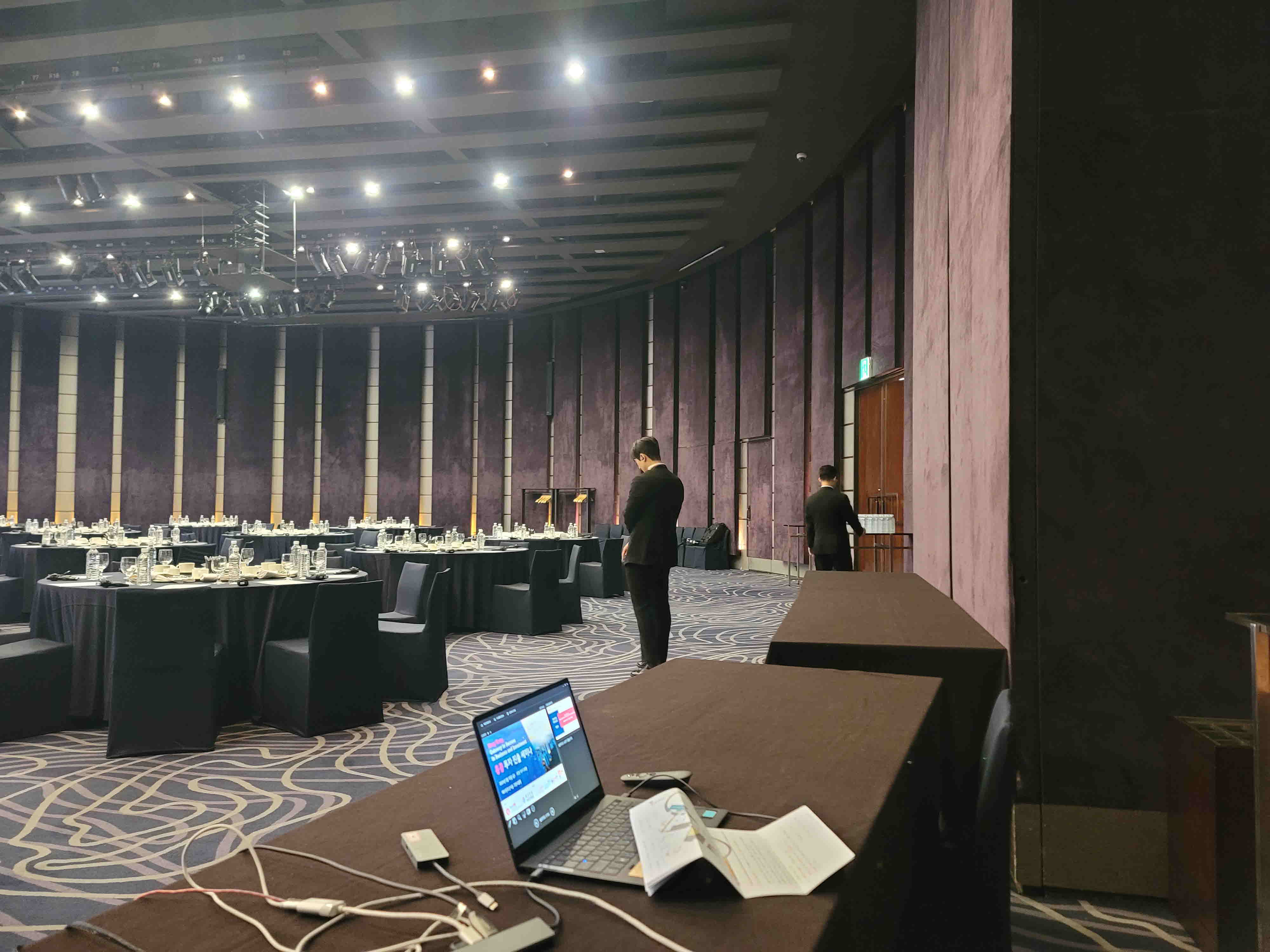
1. Event Overview
This policy seminar brought together domestic and international policy experts and public-sector representatives to engage in in-depth discussions on climate change response, industrial transformation, and international cooperation policy.
English–Korean simultaneous interpretation (SI) and consecutive interpretation (CI) were provided to ensure that policy statements and discussions were delivered accurately and contextually.
Policy seminar interpretation is a highly specialized domain in which a single expression may influence policy interpretation and practical decision-making.
2. Complexity Analysis
Policy seminars typically involve:
-
Simultaneous reference to legal frameworks, institutional structures, and statistical data
-
Discussions of international agreements and comparative policy models
-
Frequent mention of numerical targets, timelines, and regulatory mechanisms
-
Diplomatic nuance embedded in policy language
-
Spontaneous policy interpretation required during Q&A sessions
In particular, institutional design structures and regulatory scope require precise contextual delivery.
3. Scope of Interpretation
-
Consecutive interpretation for policy presentations and keynote briefings
-
Simultaneous interpretation for international expert sessions
-
Policy discussions and Q&A interpretation
-
Legal, institutional, and statistics-based presentation interpretation
-
Facilitation of policy communication among multinational participants
4. Key Interpretation Topics
1) Climate Change Response Policy
-
Carbon reduction strategies
-
Carbon Border Adjustment Mechanism (CBAM) structure
-
International cooperation mechanisms
2) Industrial Transformation Policy
-
Energy transition roadmaps
-
Industrial competitiveness strategies
-
Public–private cooperation frameworks
3) International Cooperation & Regulatory Comparison
-
Comparative national policy approaches
-
Interpretation of international agreements
-
Multilateral cooperation frameworks
Numerical data, institutional structures, and diplomatic expressions were delivered in balanced and structured form.
5. Core Operational Indicators
| Category | Details |
|---|---|
| Event Type | Policy Seminar |
| Interpretation Mode | Simultaneous + Consecutive |
| Policy & Legal Content | Approx. 60% |
| International Cooperation Content | Approx. 30% |
| Q&A Ratio | Approx. 20–30% |
| Participants | Government · Public Institutions · International Experts |
6. Pre-Event Preparation & Strategy
-
Detailed analysis of keynote texts and presentation materials
-
Advance review of relevant legislation and policy documents
-
Compilation of international agreements and comparative policy materials
-
Development of policy and institutional terminology glossaries
-
Repeated verification of numerical data, timelines, and regulatory structures
This preparation ensured that policy context was consistently preserved during interpretation.
7. Key Operational Considerations
-
Maintaining accuracy in policy, legal, and institutional terminology
-
Rigorous verification of numerical data, statistics, and timelines
-
Preventing distortion of speaker intent
-
Preserving deliberately ambiguous policy language where appropriate
-
Maintaining neutrality and balance
Policy interpretation prioritizes contextual preservation over excessive paraphrasing.
8. Application of the QMS 9-Step Quality Management System
-
Analysis of policy scope and key issues
-
Collection of legal and statistical materials
-
Integration of policy-specific terminology
-
Matching with public policy-specialized interpreters
-
Presentation structure rehearsal
-
Verification of numerical data, timelines, and regulatory expressions
-
On-site quality monitoring
-
Q&A response support
-
Post-event feedback and continuous improvement
9. Performance Outcome & Participant Feedback
Complex policy terminology and institutional explanations were delivered clearly, allowing discussions to proceed smoothly without disruption.
Participants noted that policy deliberations were conducted more efficiently, with enhanced clarity and productivity.
Interpretation extended beyond language conversion, contributing directly to the effectiveness and depth of policy dialogue.
10. FAQ
Policy Seminar Interpretation
1) Why is interpretation important in policy seminars?
Policy seminars often involve discussions on legal frameworks, regulatory structures, international cooperation, and public policy strategies.
Professional interpretation ensures that policy statements, institutional terminology, and diplomatic nuances are accurately conveyed to all participants.
Accurate interpretation helps policymakers, researchers, and public institutions exchange ideas effectively and make informed decisions.
2) What makes interpretation in policy seminars particularly complex?
Policy interpretation requires understanding multiple domains simultaneously, including:
-
Public policy frameworks and governance structures
-
Legal and regulatory terminology
-
Statistical indicators and policy targets
-
International agreements and diplomatic language
-
Institutional processes and administrative systems
Even small differences in wording can affect how policies are interpreted or implemented.
3) What interpretation methods are typically used in policy seminars?
Policy seminars often use a combination of simultaneous and consecutive interpretation.
-
Simultaneous interpretation (SI) is commonly used for keynote speeches and expert presentations.
-
Consecutive interpretation (CI) is often used for policy briefings, discussions, and Q&A sessions.
This mixed format allows both formal presentations and interactive policy discussions to proceed smoothly.
4) How do interpreters prepare for policy seminars?
Preparation usually includes:
-
Reviewing policy documents, legislation, and institutional materials
-
Studying international agreements and regulatory frameworks
-
Building glossaries of policy and legal terminology
-
Analyzing statistical indicators, timelines, and policy targets
-
Preparing for potential Q&A topics related to policy implementation
This preparation ensures accurate interpretation of complex policy discussions.
5) What topics are commonly discussed in international policy seminars?
Typical topics include:
-
Climate change policy and environmental governance
-
Industrial transformation and economic policy strategies
-
International cooperation frameworks
-
Regulatory reform and institutional design
-
Public–private partnership models
-
Comparative policy analysis among countries
These discussions require interpreters to understand both policy substance and institutional context.
6) Why is neutrality important in policy interpretation?
Policy discussions often involve political perspectives, regulatory positions, and international negotiation frameworks.
Professional interpreters must maintain strict neutrality, ensuring that speakers’ intentions and policy positions are conveyed accurately without interpretation bias.
Neutral delivery helps preserve the credibility and balance of policy dialogue.
7) How does UNIVERSE RB ensure interpretation quality in policy seminars?
UNIVERSE RB applies its QMS 9-Step Quality Management System, including:
-
Policy scope and issue analysis
-
Integration of legal and institutional terminology
-
Matching interpreters with public policy expertise
-
Verification of numerical indicators and regulatory expressions
-
Structural rehearsal of presentations
-
On-site quality monitoring
-
Post-event feedback and continuous improvement
This structured approach ensures reliable interpretation in complex policy discussions.
8. Who typically participates in international policy seminars?
Participants usually include:
-
Government officials and public-sector agencies
-
International organizations and development institutions
-
Policy researchers and think tanks
-
Academic experts and universities
-
Industry representatives and NGOs
Professional interpretation enables productive communication among these diverse stakeholders.
In large-scale international seminars, stable multilingual communication is achieved when interpretation systems, technical equipment, and interpreter operations are designed as an integrated architecture.
11. Conclusion
Policy seminar interpretation is a high-level professional field that requires coordination of linguistic precision with policy context, legal structure, and international environment.
Accuracy, neutrality, and contextual alignment are decisive factors in ensuring the credibility and effectiveness of policy communication.
This
case represents one of the sessions conducted as part of international policy
cooperation and global governance discussions.
Policy environments and international cooperation frameworks continue to evolve
in response to economic, environmental, and development policy changes.
→ Explore International Policy Forum Cases
https://universerb.com/en/11_en/56?page=41
https://universerb.com/en/11_en/71?page=39
The case archive on this
website is based on interpretation and global communication experiences
conducted in international seminars, policy forums, corporate presentations,
and industry conferences.
To comply with client confidentiality and the Code of Professional Conduct,
some event details are described in a generalized manner.