
Quotation


Performance
Public Seminar Simultaneous Interpretation | Audience Engagement Communication Forum – UNIVERSE
- 2025.07.31
Education, Leadership & Human Capital
Category Description
This category covers interpretation cases related to education innovation,
leadership strategy, digital learning, and talent development initiatives.
UNIVERSE RB provides integrated services including:
Simultaneous interpretation Consecutive interpretation Education seminar interpretation Educational material translation QMS-based quality management operations We support education conferences, leadership forums, and global talent development programs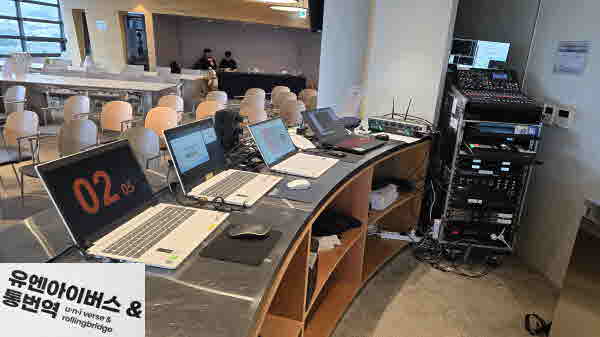
Executive Summary
Public seminar interpretation is an audience-expanded communication design targeting diverse participants.
Beyond accuracy, clarity, accessibility, and comprehension are critical.
The Q&A segment (15–30% of total time) is where quality variance most frequently occurs.
Interpretation + equipment + technical operation must be integrally designed for stability.
A structured 9-step QMS minimizes quality deviation in public environments.
1. Event Overview
Public seminar interpretation refers to interpretation services delivered at open events accessible to general audiences.
Because attendance ranges from industry experts to members of the public, terminology and expression must be adjusted to ensure broad comprehension.
In public settings, interpretation must secure:
-
Accuracy
-
Clarity
-
Audience friendliness
-
Flow continuity
Public exposure increases reputational sensitivity; therefore, balance and precision are essential.
2. How Is Public Seminar Interpretation Different from Regular Meeting Interpretation?
“Isn’t it just simultaneous interpreting?”
Public seminars present unique conditions:
-
Diverse audience knowledge levels
-
Immediate real-time audience reaction
-
Media and social media exposure potential
-
High Q&A proportion
In large-scale seminars, Q&A sessions account for approximately 15–30% of total program time, and quality gaps most often occur during this segment.
This requires not mere transmission, but audience-sensitive restructuring ability.
3. Core Roles of Public Seminar Interpreters
-
Real-time interpretation of keynote presentations
-
Interpretation of audience Q&A
-
Conveying meaning from PPTs, charts, and statistics
-
Adjusting technical terminology into accessible language
-
Reflecting live atmosphere
-
Preserving speaker intent and contextual nuance
In policy, science, or environmental seminars, high technical terminology density makes pre-event glossary preparation essential.
4. Interpretation Formats
① Simultaneous Interpretation
-
Receiver-based or online platform-based
-
Suitable for large public events
-
Maintains event flow
② Consecutive Interpretation
-
Summary delivery after speeches
-
Appropriate for high-level protocol or ceremonial segments
③ Hybrid Model
-
Simultaneous for presentations
-
Consecutive for Q&A and elaborations
Effective for structurally complex public events.
5. Required Competencies
Public seminar interpretation requires:
-
Foundational subject-matter understanding
-
Audience-level vocabulary calibration
-
Core-message compression within limited time
-
Spontaneous Q&A responsiveness
-
Sensitivity to non-verbal atmosphere
This domain demands simultaneous achievement of accuracy and comprehension.
6. Cost Structure Determinants
Cost factors include:
-
Event scale and participant count
-
Number of languages
-
Booth and receiver equipment requirements
-
Two-interpreter team operation
-
Timing of material provision
-
Rehearsal inclusion
-
On-site technical staffing
Large public seminars are structured as an integrated model of:
Interpretation + Equipment + Technical Operations
Delayed material provision increases preparation load, impacting both cost and quality.
7. Key Risks
-
Lack of pre-structured terminology
-
Absence of presentation materials
-
Audio instability
-
No interpreter rotation system
-
Insufficient Q&A response strategy
-
Failure to reflect chat or screen-sharing in online formats
In public environments, even minor errors immediately disseminate across the entire audience.
8. 9-Step QMS Application
-
Event objective and audience analysis
-
Pre-collection of presentation materials
-
Integrated terminology alignment
-
Interpreter specialization matching
-
Rehearsal and audio testing
-
Waiting room and operations management
-
On-site quality monitoring
-
Structured Q&A support
-
Post-event review and improvement integration
This framework minimizes quality deviation in open environments.
9. Practical Applications
-
Government and municipal policy briefings
-
University and research institute public lectures
-
Science, technology, and environmental open forums
-
Civil society and international organization forums
-
Large corporate brand seminars
FAQ
Q1. Why is a two-interpreter simultaneous team recommended?
A. Extended duration and high Q&A intensity require rotation to maintain cognitive stability and quality consistency.
Q2. Can technical content be understood by general audiences?
A. Core meaning is preserved while terminology is calibrated to audience comprehension levels.
Q3. Are online public seminars supported?
A. Yes. Remote Simultaneous Interpreting (RSI) can be integrated into live streaming platforms.
Q4. How is Q&A quality managed?
A. Through pre-structured anticipated question mapping, live monitoring, and contextual supplementation.
Q5. Is equipment mandatory?
A. For large-scale events, booth and receiver systems are essential; small-scale events may be adjusted accordingly.
Q6. How are interpreters selected?
A. Based on subject specialization, public event experience, and spontaneous response capability.
In large-scale international seminars, stable multilingual communication is achieved when interpretation systems, technical equipment, and interpreter operations are designed as an integrated architecture.
Conclusion
Public seminar interpretation is not simple language transfer.
It is an audience-expanded communication design process.
The challenge lies in balancing precise technical delivery with audience-level accessibility.
When supported by a QMS-based operational framework and thorough preparation, stable interpretation quality can be maintained even in highly public, high-visibility environments.
This
seminar represents one of the professional sessions sharing insights into
education innovation and talent development strategies.
Education models and leadership strategies continue to evolve alongside digital
learning environments and social changes.
→ View Education, Leadership & Human Capital Cases
https://universerb.com/en/11_en/342?page=39
https://universerb.com/en/11_en/262?page=39
The case archive on this
website is based on interpretation and global communication experiences
conducted in international seminars, policy forums, corporate presentations,
and industry conferences.
To comply with client confidentiality and the Code of Professional Conduct,
some event details are described in a generalized manner.