
Quotation


Performance
Media Interview Simultaneous Interpretation | Media Communication Forum – UNIVERSE RB
- 2025.07.31
Media interview interpretation is a specialized communication service that accurately and impartially conveys questions and responses between journalists and interviewees while preserving the intended message.
Its key role is to deliver technical terms, names, and places precisely, maintain the speaker's tone and intent, and ensure a natural conversational flow even during follow-up or unexpected questions.
In sensitive fields such as politics, economics, and the environment, a single word can influence media coverage and public perception, making linguistic precision and a strong understanding of the media landscape essential.
Investment, IR & Global Business
Category Description
This category covers interpretation cases related to investment communication, including investor relations presentations, investment briefings, and global market expansion strategies.
UNIVERSE RB provides integrated services including:
Simultaneous interpretationConsecutive interpretationIR document translationInvestment presentation interpretationQMS-based quality management operationsWe support investment briefings, IR presentations, and global business collaboration sessions with professional interpretation services.

1. Event Overview
Media interview interpretation refers to interpretation services that connect journalists and interviewees in real time.
Beyond basic meaning transfer, the interpreter must reflect:
Speaker intent
Nuance
Emotional tone
Because interview content becomes official news articles, press releases, or video records, precision in word choice and expression is critical.
Media interview interpretation is closer to record-based interpretation than event-based interpretation.
2. Why Is Media Interview Interpretation Unique?
“How is it different from regular meeting interpretation?”
Media interviews have distinct characteristics:
Statements are published in articles
Sentences may be used as direct quotations
High potential for online dissemination
Possibility of sensitive topics
High proportion of spontaneous questions
Approximately 30–50% of interview statements are directly quoted in news reports, and interpreted expressions may appear verbatim in published content.
Therefore, distortion, exaggeration, or unnecessary mitigation must be carefully avoided.

3. Core Responsibilities
Media interview interpretation includes:
Delivering questions and responses accurately and neutrally
Converting technical terminology, names, and place references correctly
Reflecting the interviewee’s tone and intent
Seamlessly connecting follow-up questions
Maintaining flow during unexpected or challenging inquiries
In political, economic, or environmental interviews, a single word choice can shift message direction.
4. Interpretation Formats
▸ Consecutive Interpretation
Note-based delivery after each statement
Most common in press briefings and official interviews
▸ Simultaneous (Live Broadcast) Interpretation
Used in live television or streaming interviews
Requires simultaneous speed and precision
▸ Stenographic / Transcription Support
Assists in recording and subtitle production
May operate alongside interpretation for official documentation
For live broadcast interviews, maintaining under one second of delay is critical.
5. Required Competencies
Media interview interpreters require:
Broad knowledge of current affairs, politics, economics, culture
Ability to construct formal, publication-ready sentences
Sensitivity in handling controversial or sensitive issues
Seamless conversational bridging skills
Composure under pressure
Media interview interpretation demands both precision and linguistic intuition.
6. Cost Structure Determinants
Cost factors include:
Interview format (in-person, broadcast, live stream)
Interpretation mode (consecutive or simultaneous)
Duration
Availability of advance question lists
Inclusion of sensitive topics
Technical broadcasting requirements
For live broadcast interviews, interpreter tier and real-time crisis management experience directly influence pricing.
7. Key Risks
Distortion of quotable statements
Overstatement or understatement of intent
Inconsistent terminology spelling
Mishandling of sensitive phrasing
Live delay or overlapping audio
In media contexts, minor phrasing differences can alter headline framing.
8. Application of a 9-Step QMS (Quality Management System)
Media interview interpretation is managed through:
Analysis of interview purpose and media profile
Collection of anticipated question lists
Background research on the interviewee
Standardization of terminology and proper names
Pre-review of sensitive expressions
Broadcasting environment and format check
On-site quality monitoring
Support for spontaneous question management
Post-interview review of published language and feedback
This structured process minimizes the risk of media misrepresentation.
9. Practical Applications
International film festival director and actor interviews
Athlete and coach interviews after sporting events
Expert interviews at international conferences
CEO interviews with overseas media outlets
Political figure interviews with international press
Operational Tips
Review anticipated questions and interviewee biography in advance
Exercise heightened caution with quotable statements
Standardize terminology and name spelling beforehand
Adapt to broadcast timing and microphone environment
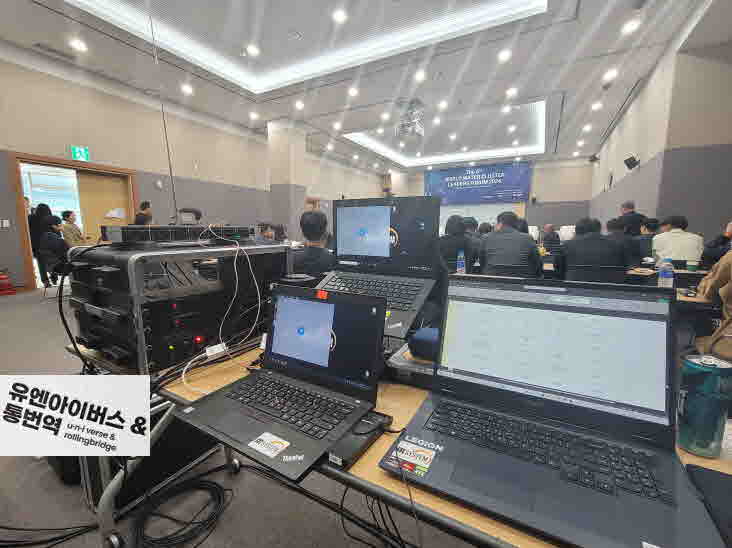
In large-scale international seminars, stable multilingual communication is achieved when interpretation systems, technical equipment, and interpreter operations are designed as an integrated architecture.
Conclusion
Media interview interpretation is not simple conversational transfer.
It is strategic interpretation designed for official record and public dissemination.
The interpreter must accurately convey intent, tone, and policy meaning.
When supported by a QMS-based preparation and risk management framework, the potential for media distortion can be significantly minimized.
This session represents one of the cases conducted as part of corporate investment communication and global market strategy discussions.
Investment strategies and market approaches continue to evolve according to global economic conditions and industry developments.
→ View Investment, IR & Global Business Cases
https://universerb.com/en/11_en/337?page=39

The case archive on this website is based on interpretation and global communication experiences conducted in international seminars, policy forums, corporate presentations, and industry conferences.
To comply with client confidentiality and the Code of Professional Conduct, some event details are described in a generalized manner.